 |
| Taken from Visocki.wordpress.com |
Friday, April 27, 2012
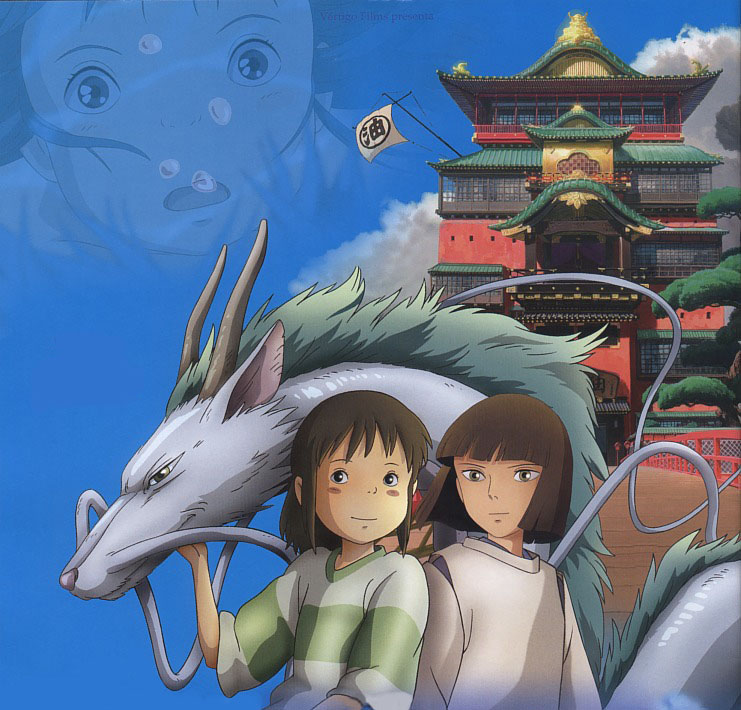
Geraci: Spirited Away

Monday, April 23, 2012
Geraci: Nausicaa: Of The Valley of The Wind
 |
| Taken from Cosplayhouse |
Friday, March 30, 2012
Geraci: Princess Mononoke
 |
| Taken from genjipress.com |
Lady Eboshi is a completely different story. She is a woman of the city, of modern advances, and of tough opposition. Lady Eboshi cannot afford to be seen as weak in front of her enemies. She hides away her emotions and embraces her life with statue-like grace. One cannot tell whether or not she is feeling vindictive, elated, or concerned. She keeps up a tough front so her enemies would think twice about messing with her. She took the women out of prostitution and put them to good, honest work, she had the men do hard labor, and she gave the lepers care and jobs. All that good is also over-shadowed by her hatred for San, the wolf tribe, and any part of nature that gets in the way of her city's improvement. Ashitaka told her a few time that she has a demon inside her. I believe that demon was greed and hatred. He had to keep telling her about her demon because she could not recognize it inside her. She is not in-tune with every aspect of herself, so she would have never been able to see how the evil inside her was taking over the good.
Friday, March 16, 2012
Geraci: Grave of the Fireflies
 |
| Taken from laurenbuckley.com |
Grave of the Fireflies is the most heartbreaking and sad anime that I have ever seen. The contrast between the playfulness of the children and the seriousness of the war that was going on around them was shown throughout the movie. When Seita and Setsuko go to their aunt’s house, they try to keep their minds off the bad that was the war, and all the death that went with it, and have some fun, so they would not be swallowed up by depression. When they are playing the piano, they are trying to regain some semblance of normality, but their aunt scolds them for being cheerful in a time of war. She kept saying how hard her family worked for the war effort, however, I think they were just using school or work as a way to distract themselves from the horror. Seita and Setsuko had no other means to do that because their school was bombed. When the aunt told them to make their own dinner, Seita tried to keep up a good attitude for Setsuko, and tried to make it fun for her. When they finally left, Seita worked really hard to keep Setsuko’s life happy and carefree. When the playful atmosphere was forcibly stripped away, they had to face the ugliness and cruelty of the adult world; a world where the people who were supposed to look out for you, did not even spare you a glance. The adults would just brush off Seita and Setsuko like they were not even there. The adults are responsible for Setsuko and Seita’s death. It was through their carelessness that brought about the starvation of both these children. Their deaths were not fair, but most deaths are not. It is a reminder that in war, not all casualties are found on the battlefield.
I forgot to read the article.
Friday, March 9, 2012
Geraci: The Harp of Burma
 |
| Taken from Animenation.net |
Sunday, February 19, 2012
Geraci--Ghost in the Shell
 |
| Taken from meuploads.com |
Friday, February 10, 2012
Geraci: Perfect Blue
 |
| Taken from ew.com |
Perfect Blue is a movie that can be hard to follow and confusing on what is real, and what is a dream. Perfect Blue is a movie inside a movie, and the plotline of both movies are very similar, which aides in the confusion of reality and the fiction of the TV-movie, Double Bind. Mima is from a small town, but she moved to Tokyo to peruse her lifelong dream of becoming a pop idol. She was happy in the beginning, but the group she was in, Cham, never made it in the Top 100 billboard. Mima wanted to be more well known, and make more money, so she switched to acting. Her desire to be seen by a wider audience caused her to be desperate for any role, which brought her to perform a rape scene in Double Bind. The scene, even though it was fake, was still very traumatic for her to do. I believe that scene was the breaking point for her. After that scene, her personality changes from the innocent pop idol into a desperate actress trying to please everyone, the men, by willingly taking off her clothes, and posing for pornographic pictures. She loses her image of herself because of a website that seems to know all her thoughts and feelings, and daily habits. She buys a computer, which exposes her to the fact that her life is not as private as she thought it was. Her assistant, Rumi, is unintentionally helping the breakdown of her mind. Rumi has multiple personality disorder, which developed when Mima did the rape scene in the movie. Rumi’s other personality is the pop idol version of Mima. Mima sees the pop idol version of Rumi and thinks it is herself. She freaks out every time she sees Rumi and believes she is losing her mind. Rumi kills the men who are responsible for Mima’s tarnished image, and the murders very closely mirror the murders in Double Bind, so Mima thinks she is the one committing the murders. When she finds out Rumi is the one committing the murders, she realizes she is not losing her mind and is able to move on.
Friday, February 3, 2012
Geraci: The Real Folk Blues
 |
| Taken from Quackpot.com |
In both the television series and the movie, Cowboy Bebop centers on Spike Spiegel as the main character. Even though people constantly surround him, he always seems to be alone. He always distances himself from people probably so he would not be hurt or betrayed again. Spike has a caring nature that he has to suppress in order to survive in a world that wants him dead. Even in the syndicate, Spike took care of the young recruits in a way that shows he is both a badass and a good person. In the movie, Spike shoots a convenience store robber who had an old woman at gunpoint. Spike said he did not care about the woman, but he shot him before the guy had the chance to kill her. Spike was confident in his ability to shoot with more accuracy and quickness than the robber was. Another scene in the movie that highlights Spike’s conflicting actions and words is his pursuit of Vincent. Jet tells Spike there is no need to go after the bounty on Vincent; there are bigger bounties out there. However, Spike is not concerned about the bounty on Vincent anymore; he is worried about all the people on Mars. He also wants to stop Vincent to help Elektra in her goal to help Vincent remember. Elektra used to be Vincent’s lover and comrade, and it pains her that he has lost all memory of her. She feels like she needs to be the one to defeat Vincent, and in the end she does. She shot the man she loved, and put him back in his right state of mind. Spike was able to save the world with the help of the Bebop crew, a few old men, and Rashid. Without his knowledge, Spike would never have known of the nano-bots. Spike is a lone ranger who relies on the aid of those around him, even when he downplays their help.
Friday, January 27, 2012
Geraci--Ninja Scroll
 |
| Image from Nightfall.com |
Ninja Scroll is a violent, erotic, and beautifully done movie. Ninja Scroll is a historical fiction anime. Jubei was a real samurai in Japan’s era called the Warring States. The legend that surrounds him is not all that different from England’s Robin Hood. Jubei’s name is well known to every Japanese citizen, and his resistance to the Tokugawa Shogunate. Ninja Scroll illustrates well the discard between Jubei and the Japanese citizens, and the Tokugawa Shogunate. The Tokugawa Shogunate wanted to centralize government, while diminishing the rights of all the citizens. The film is showing the importance of rebelling against a corrupt government that has no interest in the well-being of its people. Jubei is a beacon of resistance and hope for the oppressed citizens. Even today, Jubei is looked upon with admiration and gratitude. In Ninja Scroll, Jubei, Kagero, and Dakuan must face the eight demons of Kimon. Jubei is able to defeat five of the eight demons with a humble attitude and great sword skill. Kagero killed two demons with the poison her body naturally produces. The demons had power, but they were not humble in their ways, which lead to their downfall. I think this shows, very accurately, how having power is not everything someone needs to be strong. In this case, having power and arrogance leads straight to death. I do not think Yurimaru was as arrogant as the other demons, (this could be because he was my favorite, and I am blinded to his flaws) so his death was not due to overconfidence. His death was due to the jealousy of one of his fellow demons, Zakuro. Her jealousy of Yurimaru and Gemma’s love drove her to kill the man she claimed to love. The mentally of, “if I can’t have him, no one will!” Ninja Scroll uses the natural world to tie in the elements of Shintoism, and it uses the demons to bring in Buddhism. The combination of Shintoism and Buddhism serves as a reminder that live and death walk hand in hand.
Friday, January 20, 2012
Geraci--Akira
 |
| Taken from Nerdreactor.com |
For the average American viewer, Akira is a weird and disturbing movie. Even for an American otaku, Akira can seem strange; however, we can also appreciate it for the masterpiece it is. The anime movie Akira revolves around a series of complex issues, and cultural references that people who are not native to Japan would not understand. In Japan, media censorship is not a new idea. The government does not want to upset the Japanese people with unpleasant news. In Akira, the government is not censoring the media for the sake of their people, but for their own sake. To keep the people from finding out what the government and military are doing on their own. They are trying to control what the people know about the resistance and the genetic experiments they perform on helpless children. The military is in-charge of the scientist who performs the experiments on the children. I believe this is a major indicator of military intent to use the children as their weapons and tools against Akira, and possibly the resistance. The experiments age the children dramatically in physical features, which make them look like small, old people. The drugs the scientist use boost the physic powers of the children, which is most likely the cause of their rapid aging. These kids did not go through these tests willingly; they were, most likely, taken off the street like one of the main characters, Tetsuo. Tetsuo is in a motorcycle gang with the other main character, and his best friend, Kaneda. Both of them take a part in the teen-age rebellion against the government and war, just in a different way than the people in the resistance army. Kaneda and his gang are more concerned with resisting authority and rebelling against the adults who look down on them. The people in the resistance army are more concerned with government and military action/control in the country. Most of the action in the movie revolves around a person named Akira. Akira is never seen until the very end, and even then, he is just chopped up body parts. Akira seems to be the manifestation of hope and terror in the people in Tokyo. Hope for the oppressed, and terror for the oppressors. Akira is believed to be the bringer of justice and judgment, like a type of new god. I believe Akira was a young boy with great power that went out of control and destroyed everything. I think Akira was made into a bigger phenomenon than he actually was.
Thursday, January 12, 2012
Geraci: All About Lovie Jean

My Name is Lovie Jean and I am the fourth Lovie in my family. My great-grandmother was born on Valentine’s Day and her nick-name was Lovie, then my grandmother, then my mother, and now me. Jean is my dad’s mom’s name. I have a younger sister whom I love dearly, even if she is the exact opposite of me. My friend Kellie got me interested in anime in the fifth grade with inuYasha. That was the beginning of the end. The first time I went to an anime convention was in 2006 at Akon in Austin, Texas with my mom and one of my friends. My sister, who just turned 12, went with us to the hotel, and completely freaked out when she saw all the people who were cosplaying. She had to stay with a friend that lived nearby for the remainder of the convention. The years after, I decided to go to a more local convention, Mechacon. I have been going to Mechacon for five years, and I bought a gold pass for the past two years. I have seen a lot of anime, but my favorites are Code Geass, Full Metal Alchemist, Full Metal Alchemist Brotherhood, and Fooly Cooly. InuYasha will always have a special place in my heart as my first anime. I have about 297 manga on my book shelf, and I am running out of space. I have plenty of anime magazines such as, Shonen Jump, Shojo Beat, Yen+, and other miscellaneous magazines. I am an International Business major and I really want to work in the anime industry, hopefully in Funamation or Viz Media. I do not know exactly what I want to do in the industry, but I know for sure I want to work with anime. I am taking Japanese, so maybe I will be a translator, or consultant.
Subscribe to:
Comments (Atom)