Friday, April 27, 2012

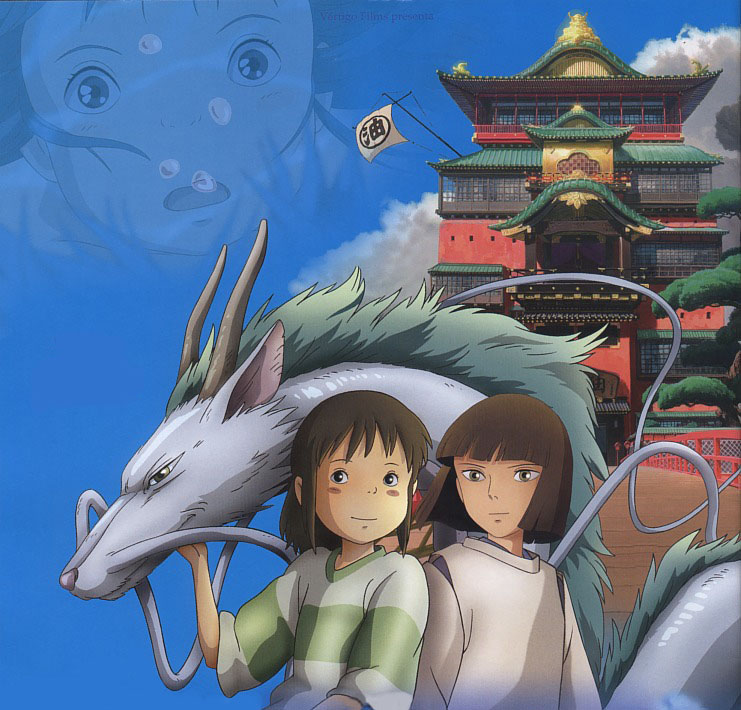
Geraci: Spirited Away

Taken from Visocki.wordpress.com
Spirited Away is one of Hayao Miyazaki's masterpieces. His use of the film to make the audience think of complex issues such as the environment, human greed, and desecration of or indifference to Japanese religion and tradition is just beautiful. In the beginning of the film, Chihiro and her family are moving to a new house in a new neighborhood. They get lost on the way, and while they are driving on the "short-cut," the pass small temples that are meant to house little spirits. However, the houses are in disrepair and have not seemed to be taken care of properly in a long time. This shows one aspect of people's indifference to Japanese tradition. This shows the people's disrespect toward the spirits who used the houses. At the end of the road was what seemed like an abandoned theme park. Chihiro's parents found some food on a counter unattended, and decided to just dig in. They were stuffing their faces with so much food that they turned into pigs by a magical spell. In this scene, Miyazaki is demonstrating what greed can and will turn us into, if we are not careful. When Chihiro could not get back to the other side of the river, and back to the human realm, Haku came to her rescue and helped her get a job at the bath house. She made a deal with Yubaba, the witch in charge of the bath house, and signed her name over to her. While she is there, most of the spirits working there did not like her because she was human. They knew what humans did to the human realm, and they did not like that one bit because it had sever affects in the spirit realm. While working at the bath house, a customer came that smelled awful. Yubaba thought it might have been a stink spirit, and she sent Chihiro to help him out. While she was helping to clean the spirit, she noticed what seemed to be a thorn in the spirit's side. Chihiro helped remove the object from the side and it turned out to be a lo of junk. The stink spirit was actually a river god! This scene clearly show how human pollution is hurting our environment physically and spiritually.  

Monday, April 23, 2012

Geraci: Nausicaa: Of The Valley of The Wind

Taken from Cosplayhouse
Nausicaa is the young princess of her kingdom which lies in the Valley of the Wind. She is a strong willed girl, and is not afraid of what she has to do to protect her kingdom. While there are soldiers in the kingdom, she is the one who does the most in terms of defense for her kingdom. There are very few things that scare Nausicaa, the main thing is letting her people be destroyed by the Toxic Jungle or rampaging Ohmu. She does not seem to fear for her own life from what we see in the scene when she stands in front of the Ohmu to return their baby and appease their anger. When the cargo plane is going down over the Toxic Jungle, she takes off her mask to calm down the guards from her village. When the Tolumekian army comes to the Valley, the guards and Nausicaa try to fight them off, but then Nausicaa stops the fighting because her father was killed and she did not want anyone else she loved to die. Nausicaa is an explorer type, and she is not afraid to go into the Toxic Jungle to look around and collect things her village needs, but is not readily available. She has a kind and caring heart, which allows her to save people who threaten her Valley. She does not care if the person or insect she is defending will turn around and attack her because she was raised to fight for those who need her help. Even though she is a young princess, she maintains a warrior for peace mentality. Nausicaa of the Valley of the Wind shows the complex relationship between people, people and nature, and royalty and their people. There is a balance to be upheld, and Nausicca is the one to do it.

Friday, March 30, 2012

Geraci: Princess Mononoke

Taken from genjipress.com 
Princess Mononoke has a variety of complex characters. San, for example, has intense emotions that are never hidden away from other people. She does not even try to hide her intense hatred for humans. I think that is because she was raised in the forest among the wolves. When she grew up, she was probably taught not to hide away her emotions because cutting off a part of herself would endanger her life. There is a good and evil going on inside of San. There is good and evil going on inside all of us, but San is more in tune with every aspect of herself, and she is able to freely act upon what she feels without second-guessing herself. San grew up in the forest, it is and will always be her home and the only place she feels comfortable. She loves the forest and every animal and plant in it. She respects the life and death of every creature, except the humans. The good in her is heavily over-showered by the blinding hatred she feels for the humans. Her hate is not something that could ever fully disappear. Her hatred runs deep in her veins and she is not afraid to show it to those she does not like. The evil inside her can not be scrubbed away by Ashitaka's love and kindness. Perhaps, in time, she would be able to trust the humans.

Lady Eboshi is a completely different story. She is a woman of the city, of modern advances, and of tough opposition. Lady Eboshi cannot afford to be seen as weak in front of her enemies. She hides away her emotions and embraces her life with statue-like grace. One cannot tell whether or not she is feeling vindictive, elated, or concerned. She keeps up a tough front so her enemies would think twice about messing with her. She took the women out of prostitution and put them to good, honest work, she had the men do hard labor, and she gave the lepers care and jobs. All that good is also over-shadowed by her hatred for San, the wolf tribe, and any part of nature that gets in the way of her city's improvement. Ashitaka told her a few time that she has a demon inside her. I believe that demon was greed and hatred. He had to keep telling her about her demon because she could not recognize it inside her. She is not in-tune with every aspect of herself, so she would have never been able to see how the evil inside her was taking over the good.

Friday, March 16, 2012

Geraci: Grave of the Fireflies

Taken from laurenbuckley.com

Grave of the Fireflies is the most heartbreaking and sad anime that I have ever seen. The contrast between the playfulness of the children and the seriousness of the war that was going on around them was shown throughout the movie. When Seita and Setsuko go to their aunt’s house, they try to keep their minds off the bad that was the war, and all the death that went with it, and have some fun, so they would not be swallowed up by depression. When they are playing the piano, they are trying to regain some semblance of normality, but their aunt scolds them for being cheerful in a time of war. She kept saying how hard her family worked for the war effort, however, I think they were just using school or work as a way to distract themselves from the horror. Seita and Setsuko had no other means to do that because their school was bombed. When the aunt told them to make their own dinner, Seita tried to keep up a good attitude for Setsuko, and tried to make it fun for her. When they finally left, Seita worked really hard to keep Setsuko’s life happy and carefree. When the playful atmosphere was forcibly stripped away, they had to face the ugliness and cruelty of the adult world; a world where the people who were supposed to look out for you, did not even spare you a glance. The adults would just brush off Seita and Setsuko like they were not even there. The adults are responsible for Setsuko and Seita’s death. It was through their carelessness that brought about the starvation of both these children. Their deaths were not fair, but most deaths are not. It is a reminder that in war, not all casualties are found on the battlefield.

I forgot to read the article. 

Friday, March 9, 2012

Geraci: The Harp of Burma

Taken from Animenation.net 
   The Harp of Burma, is not like any anime I have seen recently. The animation is low budget, the characters are not cleanly cut, and the story line is relatively simple. The setting of this anime is in Burma around when WWII ended. The group that we follow has learned how to sing from their leader so when they are low on morale, they can sing away their troubles for a while. The character who can play the Burmese Harp, Mizushima, is a good man with a strong sense of duty. This sense of duty leads him to stay behind to bury the people who were killed in the war and whose bodies were left out in the open where animals can get to them. Death is a big part of Japanese culture. Americans tend not to put death as a major role in television, especially suicide. In Japan, suicide is a major part of history. There are two distinct types of suicide, and they way they are looked at is different. The respected suicide is the type that is to regain honor or in battle, i.e. suicide missions. These types of suicide are regarded very highly. In Letters to Iwo Gima, a group of soldiers commit  suicide because their superior ordered them to. I think he did this to ensure none of his men would be treated brutishly by the American soldiers. The other type of suicide is when someones kills themselves over a lost love or not doing well in school. This type of suicide is looked down on and is not considered honorable at all. Americans, most of the time, see suicide as sin because of or Judeo-Christian beliefs. Committing suicide is killing God's creation, and that is a sin. The Harp of Burma is about taking care of the dead who fought with honor. It is a peaceful movie with a positive message about humanity.

Sunday, February 19, 2012

Geraci--Ghost in the Shell

Taken from meuploads.com 
     Ghost in the Shell is about blurring the lines between humans and machines. The lines that divided us were quite clear until people started to enhance their bodies by using robotics. For some people, like the major, there is significant robotics done to the body. The question of  when we stop being human, and start being an A.I. is important. Are we human because our bodies are made of living flesh? Or is it because we can infer and reason? Perhaps it is because we have a soul that helps us to interact and better understand each other. I think it is a combination of all of these. However, I think the soul part is the most important, so if someone loses his or her body parts and needs prosthetic limbs, they are still human. There are many issues concerning identity in Akira, Perfect Blue, and of course Ghost in the Shell, but I do not feel as though my identity was threatened or affected. I know who I am, and only something traumatic would affect my sense of identity. The characters in Akira and Perfect Blue went through something terrifying and riddled with the unknown.  Their sense of self was challenged by their environment and a series of circumstances that blurred the lines of reality and fantasy. In Ghost in the Shell, the major’s conflict is whether or not she was fully human. This is not something I can relate to because all of me is still original. The conflict the major faces is through the fact that she was mostly made not born. The human soul is something that cannot be fully made. The “souls” A. I.s have is called a ghost, it is a substitute soul that is nowhere near as complex as a human soul because it is a computer program. Real human souls cannot be duplicated. Cyborg bodies also go by the term “shell,” which is how we get the title Ghost in the Shell.

Friday, February 10, 2012

Geraci: Perfect Blue

Taken from ew.com


Perfect Blue is a movie that can be hard to follow and confusing on what is real, and what is a dream. Perfect Blue is a movie inside a movie, and the plotline of both movies are very similar, which aides in the confusion of reality and the fiction of the TV-movie, Double Bind. Mima is from a small town, but she moved to Tokyo to peruse her lifelong dream of becoming a pop idol. She was happy in the beginning, but the group she was in, Cham, never made it in the Top 100 billboard. Mima wanted to be more well known, and make more money, so she switched to acting. Her desire to be seen by a wider audience caused her to be desperate for any role, which brought her to perform a rape scene in Double Bind. The scene, even though it was fake, was still very traumatic for her to do. I believe that scene was the breaking point for her. After that scene, her personality changes from the innocent pop idol into a desperate actress trying to please everyone, the men, by willingly taking off her clothes, and posing for pornographic pictures. She loses her image of herself because of a website that seems to know all her thoughts and feelings, and daily habits. She buys a computer, which exposes her to the fact that her life is not as private as she thought it was. Her assistant, Rumi, is unintentionally helping the breakdown of her mind. Rumi has multiple personality disorder, which developed when Mima did the rape scene in the movie. Rumi’s other personality is the pop idol version of Mima. Mima sees the pop idol version of Rumi and thinks it is herself. She freaks out every time she sees Rumi and believes she is losing her mind. Rumi kills the men who are responsible for Mima’s tarnished image, and the murders very closely mirror the murders in Double Bind, so Mima thinks she is the one committing the murders. When she finds out Rumi is the one committing the murders, she realizes she is not losing her mind and is able to move on.